
What Schedule Compliance Can't See

How do you find out whether next week's schedule was any good? In most maintenance departments the answer comes a week late, as a schedule compliance figure, after the crew has already worked the week.
Britain's Office of Rail and Road asks the question earlier. In its annual assessment of Network Rail, published on 30 September, ORR looked at how ready Network Rail was in March 2026 for the year of renewals that began in April. By March, Network Rail had authorised 66 percent of planned renewals spending against a target of 84 percent. It had also secured 109 percent of the track access the work needs, which ORR describes as a buffer "to manage potential slippage." ORR calls these leading indicators of delivery confidence, and they are useful because they arrive while the plan can still be fixed.
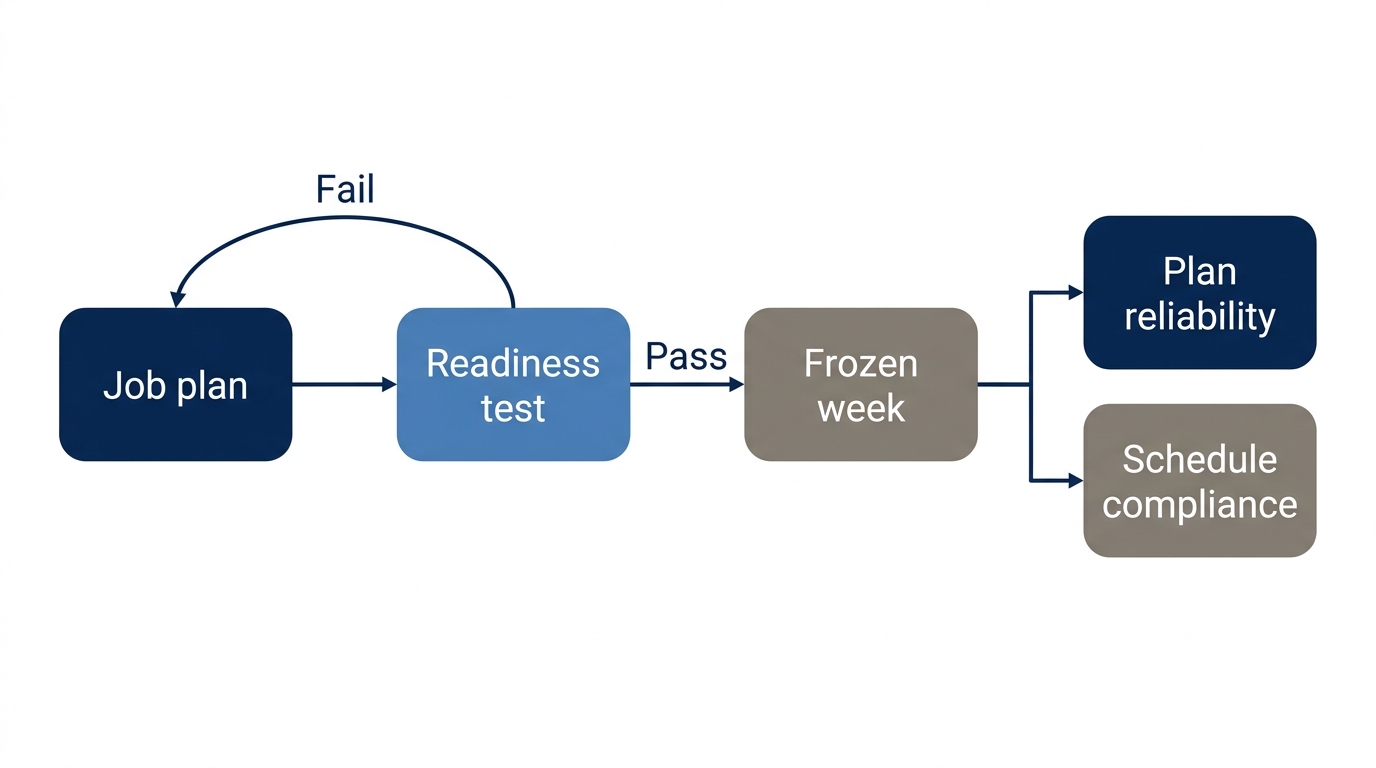
Schedule compliance works the other way round. It reports the share of frozen work that got done, and it reports it after the week is over. When a job misses because the estimate was wrong or a part never arrived, compliance records the miss and says nothing about the plan behind it. So the pressure lands on the crew and the expeditor, and the planning that produced the miss runs again the following week. We think planning and scheduling need separate numbers, read side by side, and that "ready" should mean a job passed a test that someone could have failed.
King's Cross, Paddington and the 98 percent
Over Christmas 2014, Network Rail planned 2,445 possessions, the blocks of time when a line is closed to trains for engineering work. Forty overran, so 98 percent were handed back on time. ORR said it monitored overrun prevention "principally" by checking "whether the overall proportion of possessions that overrun is stable," and the figure had held at 98 percent since 2011-12.
Two of the forty were at King's Cross and Paddington on 27 and 28 December, and together they disrupted more than 115,000 passengers. King's Cross alone caused 8,659 delay minutes, the second worst incident on that route that year. ORR found "weaknesses in NR's planning, oversight and the incident response which followed," and it called the absence of contingency arrangements for 27 December "a failing in the planning stage."

ORR did look beyond the percentage. It reviewed the readiness reports Network Rail produced one, four and eight weeks before major works, a process Network Rail made mandatory after its 2008 fine. Its principal indicator still counted hand-backs, though, and both failed plans sat inside a figure that looked stable. It seems clear that a KPI for percentage compliance can make all seem well, when it isn't.
The bill for unsound plans
The 2014 overruns ended without a fine because Network Rail accepted ORR's recommendations. The overruns at Rugby, Liverpool Street and Shields Junction over Christmas 2007-08 were more expensive. Network Rail estimated their cost at £21.3 million, and ORR fined it £14 million for "systemic weaknesses" in how it planned and executed engineering work. ORR concluded that "most of the disruption experienced should have been avoidable with better planning and management of the projects involved." At Shields Junction, the time needed to relay track panels was underestimated and the programme slipped six hours.
US Navy shipyards put a daily price on the same problem. In 2020 the Government Accountability Office found that unplanned work, "work identified after finalizing maintenance plans," contributed to more than 4,100 days of delay and to a 36 percent underestimate of the people the work needed. GAO's August 2026 report on attack submarines doesn't attribute its delays to planning, but it prices each day of delay at $219,700 to $237,080 per submarine. It puts the cost of maintenance delays and idle time at about $3.4 billion "to sustain crews and submarines that provided no operational capability."
Some of the cost falls on the people doing the work. At Cardiff East Junction in 2016, rail accident investigators found it possible that an overrun and the push to recover time, "coupled with fatigue," led a worker to decide he had no time to check. Route-proving trains on the same job were cancelled to claw back time, and the report puts it bluntly when it says, "Time was saved by not running them."
Every figure here comes from a railway or a shipyard, because those are the organisations whose failures get investigated in public. A plant's weekly schedule is built from the same estimates, parts and ready flags, which suggests it fails in the same ways without a regulator writing it up. The same reading suggests that Network Rail's 109 percent of access is partly a payment in advance for plans it doesn't fully trust.
What Does the "Ready" Flag Mean on Work?
The International Atomic Energy Agency's 2024 guidance on nuclear work management describes readiness reviews "performed without physically looking at parts, only to find out that on the day of execution the part is not the correct part or is not actually available even though the computer showed it was available."
The same document gives planning and scheduling separate jobs. Planning is "the sub-process for enabling safe and efficient execution of works with minimized risks," which covers whether resources are secured and whether the work package carries enough technical detail. Scheduling is "the sub-process for ensuring that safe and efficient works are implemented without any unnecessary conflicts of areas and resources between groups/organizations."
The ready status is where the planner hands the job to the scheduler, and the scheduler builds the week on it with no way to test it. So look at how your own EAM sets that status. If a planner sets it by hand and nobody physically confirms the job is ready, your week rests on the planner's judgement.
Percent plan complete
Construction measured this problem before maintenance did. Glenn Ballard's 2000 thesis, the work behind the Last Planner System, starts from the finding that "only about half of the assignments made to construction crews at the beginning of a week were completed when planned." Ballard tested each assignment before it entered the week and counted it sound only when every one of these questions got a yes.
- Are all materials on hand?
- Is design complete?
- Is prerequisite work complete?
He then measured the plan itself. Percent plan complete (PPC) is planned activities completed divided by activities planned, and Ballard defines plan reliability as "the extent to which a plan is an accurate forecast of future events, measured by PPC."
PPC measures the plan and nothing more. Ballard wrote that quantifying its benefits "will be a matter for future research," and a 2025 International Group for Lean Construction paper found only a weak correlation between PPC and productivity in the best-known study. A planning department still needs the number, because it tells the department how often its plan was right.
Put these measures side by side and none of them gets you very far on its own. Schedule compliance tells you the week went wrong without saying why. A ready flag tells you a planner believed the job was ready. PPC tells you how often the plan held, but not which part of it failed. ORR's principal indicator stayed steady at 98 percent while two plans failed in front of 115,000 passengers. Each number reports on the job after the fact, and nothing tests the job before it enters the week.
A readiness test someone can fail
The answer is to give the ready flag something to stand on. Before a job enters the frozen week, it should pass a short test that a planner could fail and a scheduler could check. The results should then be reported next to schedule compliance, so that every miss is traced either to the plan or to the work. A department can do this with the EAM it already runs, and we would build the test from four published practices.
- Check material physically. US Department of Energy maintenance guidance says parts "should be identified for specific work packages and segregated from other stock inventory," and that material problems "should be identified early to permit contingency planning."
- Date the freeze and measure what survives it. The IAEA's scope stability indicator "measures additions and deletions from scope freeze until the start of execution week." TEPCO, in a good-practice case in the same document, targets 80 percent or more scope stability and 90 percent or more schedule stability.
- Report the plan beside the schedule. SMRP's metrics put Actual Hours to Planning Estimate and Planning Variance Index in the planning family and Schedule Compliance in the scheduling family. Put them on one page, and record whether each miss was the plan's or the work's.
- Keep fill-in work ready. The DOE guide wants each supervisor to have "sufficient fill-in work assigned to maintain crew productivity."
At the Resonance Group, we recommend that you keep the test lean and attach it to the work package rather than adding another meeting. The Nuclear Energy Institute estimated in 2016 that streamlining work-management meetings saved a typical station 80 to 96 hours of meeting and preparation time a week. Making it part of the work ensures physical checks rather than assumptions address planning. And it also provides feedback to planning.
Planning and scheduling on the Resonance Score
The Resonance Score looks at a pair of disciplines from two sides. Practice maturity covers what the organisation actually does, and system enablement covers what its EAM is configured and used for. Each side is scored from 0 to 5, the lower of the two becomes the score, and the signed gap between them is the Detuning, which shows which side to fix first. Planning–Scheduling is one of the pairs on the Score's roadmap.
On the practice side, we look for a written readiness test that a job must pass before the freeze, and for evidence that someone compares estimated hours with booked hours and acts on the difference. We also check whether planning and scheduling are held by different people, and whether missed jobs are coded to the plan or to the work. On the system side, the question is how much of the ready status the EAM can confirm from its own records. A job whose parts are staged and recorded against the work order is ready in a way the system can show, while a job with a status code set by hand is ready only because a planner said so.
The sign of the Detuning tells a site which kind of problem it has. A positive gap means planners run a good readiness discipline by hand, on clipboards and spreadsheets, with little help from the system. A negative gap means the EAM can do more than the department asks of it. Octave Attune EAM (formerly HxGN EAM) puts work order automation, labour scheduling, and stock and purchasing management in the same product as the schedule, so a site running it should ask whether its ready flag records a check someone performed or only a planner's judgement. In both cases the score rises only when the weaker side improves, so the arithmetic points at the work.
The first change costs nothing. Put a plan-reliability figure beside schedule compliance on the report your managers already read. ORR grades Network Rail's readiness before a year of renewals begins, and a maintenance department can grade its own before next Monday.
Sources
- Office of Rail and Road, Annual efficiency and finance assessment of Network Rail 2026, 30 September 2026, chapters 2 and 5. https://www.orr.gov.uk/annual-efficiency-and-finance-assessment-network-rail-2026/5-regional-performance
- Office of Rail Regulation, Investigation report: Disruption caused by engineering overruns on 27 and 28 December 2014 at King's Cross and Paddington stations, 12 February 2015. https://web.archive.org/web/20221209000326/https://www.orr.gov.uk/sites/default/files/om/investigation-report-2015-02-12.pdf
- Office of Rail Regulation, Notice under section 55(6) Railways Act 1993, 11 February 2015. https://www.orr.gov.uk/sites/default/files/om/december-2014-overruns-investigation-notice-2015-02-11.pdf
- Office of Rail Regulation, Report of ORR's Investigation into Engineering Overruns, February 2008. https://web.archive.org/web/20230324223515/https://www.orr.gov.uk/sites/default/files/om/352.pdf
- Office of Rail Regulation, Notice of proposed penalty (s.57C), 28 February 2008, and overruns enforcement documentation. https://www.orr.gov.uk/monitoring-regulation/rail/networks/network-rail/licence-enforcement-powers/enforcement-taken/overruns-documentation
- Rail Accident Investigation Branch, Report 15/2017, Cardiff East Junction, October 2017. https://assets.publishing.service.gov.uk/media/5a2a5aad40f0b659d1fca906/R152017_171030_Cardiff_East_Junction.pdf
- US Government Accountability Office, GAO-20-588, Navy Shipyards: Actions Needed to Address the Main Factors Causing Maintenance Delays for Aircraft Carriers and Submarines, August 2020. https://www.gao.gov/products/GAO-20-588
- US Government Accountability Office, GAO-26-109256, Navy Readiness: Actions Needed to Address Costly Attack Submarine Maintenance Challenges, 27 August 2026. https://www.gao.gov/products/gao-26-109256
- International Atomic Energy Agency, Effective Work Management for Sustaining Operational Excellence at Nuclear Power Plants, IAEA-TECDOC-2068, Vienna, 2024. https://www-pub.iaea.org/MTCD/Publications/PDF/TE-2068web.pdf
- US Department of Energy, G 433.1-1A Chg 1, Nuclear Facility Maintenance Management Program Guide for Use with DOE O 433.1B. https://www.directives.doe.gov
- Nuclear Energy Institute, Efficiency Bulletin 16-22, 1 September 2016.
- Herman Glenn Ballard, The Last Planner System of Production Control, PhD thesis, School of Civil Engineering, University of Birmingham, May 2000. https://etheses.bham.ac.uk/id/eprint/4789/1/Ballard00PhD.pdf
- Asmone et al., paper at the 33rd Annual Conference of the International Group for Lean Construction (IGLC 33), 2025, doi:10.24928/2025/0128.
- Society for Maintenance and Reliability Professionals, Best Practice Metrics workshop, 2018. https://pemac.org/sites/default/files/2018_SMRP_BPMW_Full_Day.pdf
- Octave, Attune EAM product page. https://www.octave.com/products/asset-performance-management/attune/eam