
Three Numbers for the Same Asset

Is it just me, or does every asset-intensive organization keep a table in its capitalization policy that nobody outside finance has read? The table assigns an estimated useful life to each asset class, and the number a new asset draws from it sets its depreciation for as long as the asset stays on the books and appears in the audited financial statements.
Who revisits that number once it is set, and what do they have in front of them when they do? In most organizations the review sits on the closing calendar inside finance and reruns the same table. The function that knows what the asset's operating environment has done to its remaining life keeps a separate estimate in a separate system, and no recurring event puts the two on the same page.
Both functions are behaving correctly, and the estimate that reaches the outside world is finance's, which was built to answer a different question.
What the useful-life table is built to do
What is depreciation for? It allocates cost to periods, and GASB Statement No. 34 at paragraph 22 requires it to be measured by allocating the net cost of depreciable assets over their estimated useful lives "in a systematic and rational manner." IAS 16, adopted in Australia as AASB 116, addresses maintenance directly at paragraph 52, where it states that "Repair and maintenance of an asset do not negate the need to depreciate it," and requires at paragraph 51 that useful life "be reviewed at least at each financial year-end."
So why does finance work from a table? Setting lives by asset class makes depreciation comparable across like assets and consistent year over year, and it keeps the audit cheap, because re-lifing individual assets on a technician's judgment produces estimate changes and audit work that finance's own users have not asked for.
One US regulator does require the engineering evidence, since FERC's Uniform System of Accounts, at General Instruction 22, tells jurisdictional utilities that "Estimated useful service lives of depreciable property must be supported by engineering, economic, or other depreciation studies." That duty covers FERC-jurisdictional utilities and licensees only.
Where the second estimate lives
Why does asset management carry a number of its own? Renewal planning needs a life estimate that reflects the asset's operating environment and what maintenance has actually done to it, and the depreciation schedule was set at capitalization and has not moved since.
The two estimates also sit at different levels of granularity, and any comparison of them has to settle which level it is working at. Finance capitalizes a bus as one asset while maintenance tracks its engine and its fare box as separate items with their own work histories.

Three life numbers in federal transit rule
Where is this mismatch written down? Federal transit regulation carries all three numbers at once.
49 CFR 625.5 defines "useful life" and "useful life benchmark" as two separate terms in one definitions section, one determined by FTA and one by the transit provider. In the preamble to the 2016 final rule, at 81 FR 48909, FTA states that "A ULB is distinct from the term 'useful life' or 'minimum useful life' that applies to FTA grant programs," where the grant term refers to the Federal financial interest in the asset, measured by time in service or accumulated miles.
The third number surfaces at 81 FR 48908, where a transit operator's comment describes the ULB as a figure that may depart from "agency depreciation schedules, which are set when the assets are placed on the agency's books."
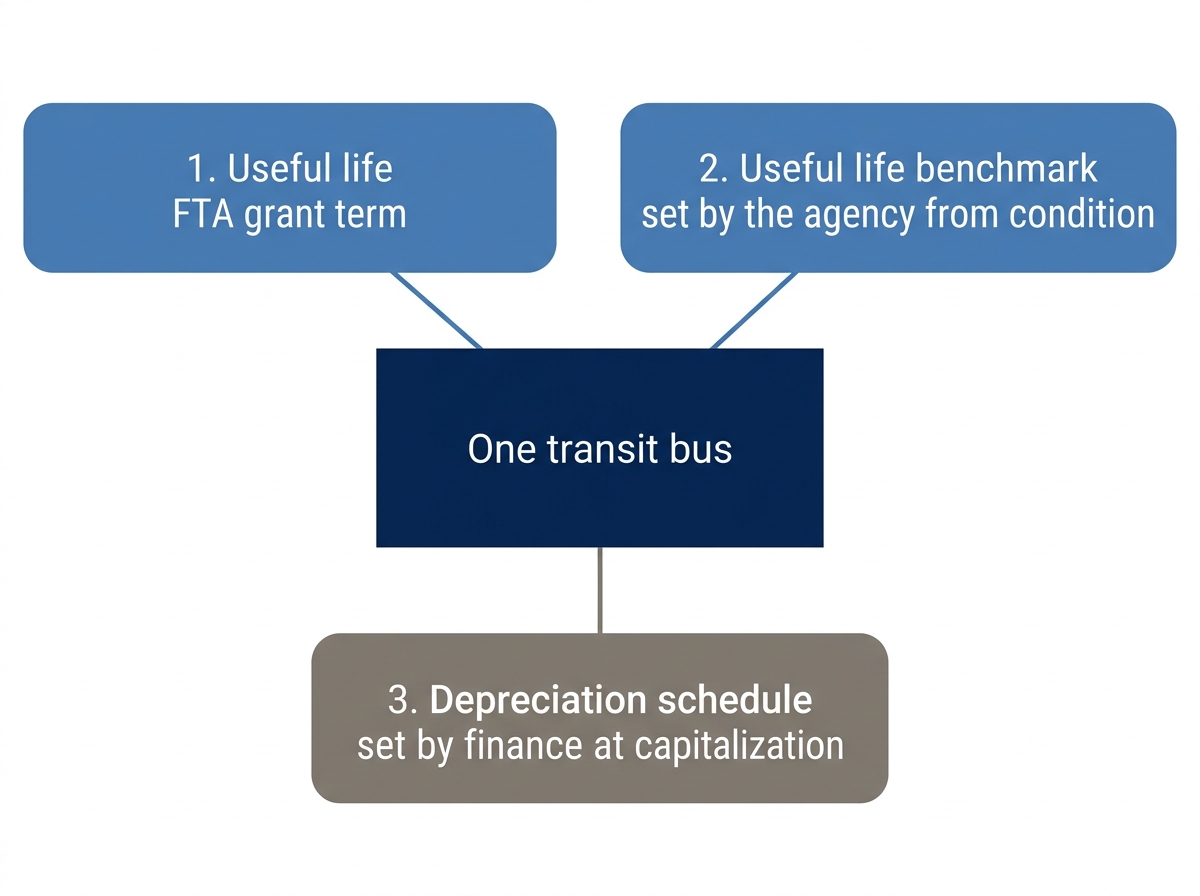
The same rule measures two asset classes by two different properties. Under 49 CFR 625.43 the state of good repair measure for rolling stock is the percentage that have met or exceeded their useful life benchmark, which counts age, and the measure for facilities is the percentage rated below condition 3 on the TERM scale. FTA's footnote 10 describes TERM as a model whose deterioration schedules "express asset conditions principally as a function of an asset's age."
Another comment at 81 FR 48908 warned that an age-based benchmark "could discourage agencies from utilizing strong maintenance practices, as even a well-maintained bus or rail vehicle would fail the test of age-based asset condition reporting." Both statements are operator submissions published by FTA as comments received.
What GASB has proposed for infrastructure assets
What happens when a figure derived from the depreciation table becomes a published disclosure? GASB's Exposure Draft on Infrastructure Assets, dated 25 March 2026, would create one.
Paragraph 11 would have governments disclose, by network, the historical cost, the accumulated depreciation and the historical-cost weighted-average age of infrastructure assets that have exceeded 80 percent of their estimated useful lives. Every input to that disclosure comes from historical cost and the estimated useful life recorded on the books, so no condition assessment touches it.
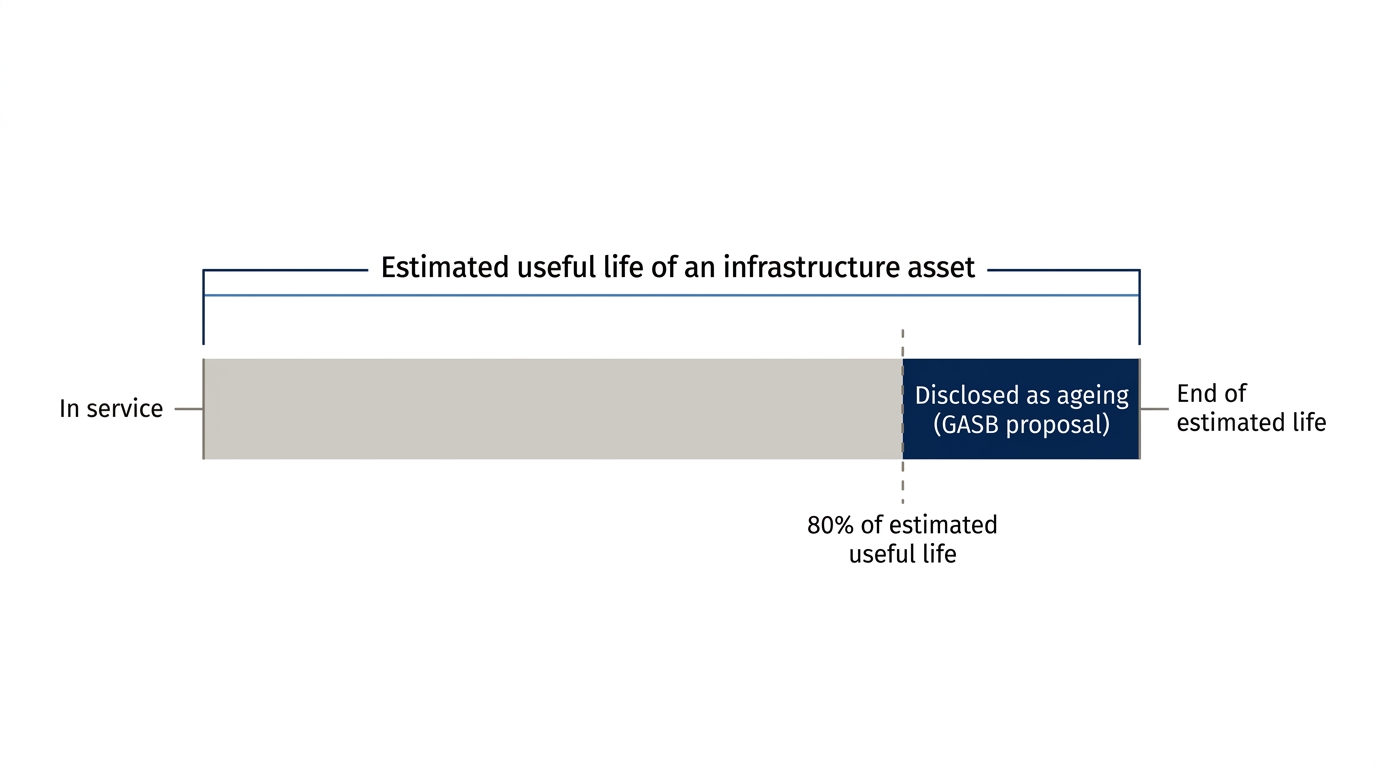
Paragraph 7 would require that "Governments should perform a periodic review of the estimated useful lives and salvage values used in the measurement of depreciation expense for infrastructure assets being depreciated." The basis for conclusions records at paragraph B17 that the Board "is concerned that governments currently may not reevaluate the estimated useful lives of their infrastructure assets as often as they should to ensure the appropriateness of that estimate." Paragraph B16 records that "a significant number of governments" carry capital assets reported as fully depreciated while those assets remain in service.
That quoted phrase is GASB's own wording and carries no figure. The Exposure Draft is a proposal, comments closed on 26 June 2026, and the proposed effective date is fiscal years beginning after 15 June 2028.
The maintenance expense disclosure GASB dropped
GASB's Preliminary Views of September 2024 went further, including a disclosure of maintenance and preservation expense on infrastructure assets that would have set a spending figure beside the ageing figure.
What came back from the field test? At paragraph B34 the Board records that "Several field test participants noted that their governments currently do not track maintenance and preservation expenses for infrastructure assets separately from those expenses for other capital assets," and that significant work would be needed to obtain the information. At B35 the Board was persuaded that the cost of separate tracking did not justify the perceived benefit, and the disclosure came out.
That is a documented cost-benefit decision reached on the evidence before the Board. The disclosure that survived is computed from the depreciation table, and the maintenance spending figure came out because governments could not assemble it.
Guidance for aligning the financial and non-financial functions
Is anyone treating this as a named problem? ISO/TS 55010:2024, "Asset management. Guidance on the alignment of financial and non-financial functions in asset management," was issued in July 2024 by ISO/TC 251 as a second edition, replacing a withdrawn 2019 edition. Its scope covers all asset types and all organization sizes.
A Technical Specification gives guidance, so ISO/TS 55010 is not certifiable and it adds no requirements to ISO 55001.
Scoring the finance and asset management pair
The Resonance Score measures a pair of disciplines on a 0 to 5 scale. It scores practice maturity on one side and system enablement on the other, reports the lower of the two as the score, and reports the gap as the Detuning, which shows which side to address first.
The flagship pair is maintenance and reliability, and finance and asset management is a named pair on the Score's roadmap. On the practice side the question is whether the periodic review of estimated useful lives pulls condition and work history into the estimate, or reruns the policy table. On the system side it is whether the fixed asset register and the EAM share an asset identity fine enough to make the comparison possible.
That comparison needs a register carrying condition and remaining-life estimates and a capital and cost view finance recognizes. Octave Attune EAM (formerly Hexagon EAM) with Octave Attune APM covers the first and Octave Sequence Enterprise (formerly EcoSys) covers the second, and the shared asset identity between them is the piece no product supplies on its own.
The Score is a new instrument, this pair has not been scored yet, and a session for it needs no new software. If you want to try it yourself this week, pull the useful-life table out of the capitalization policy, take the asset class with the largest gross book value, and ask the people who maintain those assets what they would write in that column today.
Sources
- Governmental Accounting Standards Board, Exposure Draft, Infrastructure Assets, an amendment of GASB Statement No. 34, Project No. 3-43, 25 March 2026. storage.gasb.org
- Governmental Accounting Standards Board, Preliminary Views, Infrastructure Assets, Project No. 3-43P, 30 September 2024. storage.gasb.org
- Governmental Accounting Standards Board, Statement No. 34, June 1999. storage.gasb.org
- Federal Transit Administration, "Transit Asset Management; National Transit Database," final rule, 81 FR 48890, 26 July 2016. federalregister.gov
- 49 CFR Part 625, sections 625.5 and 625.43. ecfr.gov
- 18 CFR Part 101, General Instruction 22. ecfr.gov
- Australian Accounting Standards Board, AASB 116, compiled version, paragraphs 51 and 52. aasb.gov.au
- ISO/TS 55010:2024, Edition 2, July 2024, ISO/TC 251. iso.org
- Octave, Attune EAM and Attune APM product page. octave.com
- Octave, Sequence Enterprise product page. octave.com